


Syllabus: GS3/ Economy
Context
- The Insurance Regulatory and Development Authority of India has set the vision of “Insurance for All by 2047”, aiming for comprehensive coverage across life, health, and property segments.
Insurance Sector Performance in India
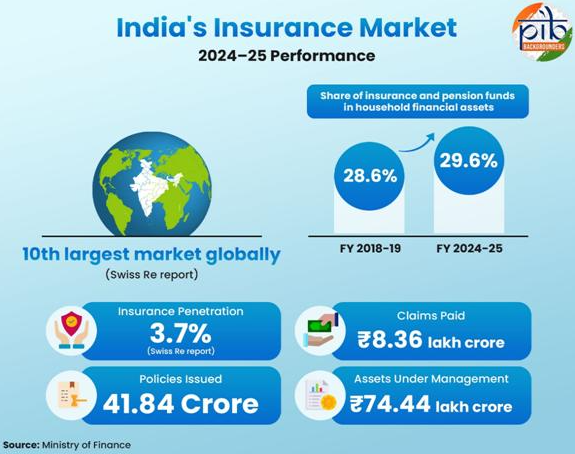
- India has emerged as the 10th largest insurance market globally with a share of 1.8% in global premium volumes.
- Insurance penetration in India stands at 3.7%, with life insurance contributing 2.7% and non-life insurance contributing 1%.
- Health insurance has emerged as the leading segment within non-life insurance, contributing 41% of gross domestic premium.
- Insurance density has increased to USD 97, reflecting gradual expansion in coverage.
Key Terms
- Insurance penetration is defined as gross premiums written for direct life and non-life insurance business as a percentage of GDP.
- Insurance density is the ratio of premiums to population (per capita premium).
- An insurance premium is the amount paid by an individual or business to obtain an insurance policy.
- The premium varies across policyholders, as it is determined by several influencing factors, such as age, area of residence, nature of employment, medical ailment, income and others.
Significance of Insurance in the Economy
- Financial Continuity: Insurance ensures financial stability by protecting households from income shocks and preventing distress sale of assets.
- Support to Investment: Insurance reduces uncertainty and provides risk mitigation, thereby encouraging entrepreneurship and business investments.
- Capital Formation: Insurance promotes long-term savings and contributes to capital formation, supporting economic growth.
Major Government Insurance Schemes
- Pradhan Mantri Jeevan Jyoti Bima Yojana: The scheme provides life insurance cover of ₹2 lakh at an affordable annual premium, ensuring financial protection to families in case of the death of the insured.
- Pradhan Mantri Suraksha Bima Yojana: The scheme provides accidental death and disability coverage at a nominal premium, making it accessible to economically vulnerable sections.
- Employees State Insurance Scheme: The scheme provides comprehensive social security covering sickness, maternity, disability, and employment injury.
- Pradhan Mantri Fasal Bima Yojana: The scheme provides comprehensive crop insurance against natural risks, ensuring income stability for farmers.
Policy and Regulatory Measures in Insurance Sector
- The Sabka Bima Sabki Raksha (Amendment of Insurance Laws) Act, 2025 has amended various provisions of the Insurance Act, 1938, the Life Insurance Corporation Act, 1956, and Insurance Regulatory and Development Authority Act, 1999, to strengthen the insurance ecosystem.
- The amendment raises the FDI limit in Indian insurance companies from 74% to 100%.
- GST exemption is granted on all individual life insurance policies and health insurance policies (including family floater) along with reinsurance w.e.f. 22 September, 2025.
- The removal of the 18% GST lowers premium costs and encourages wider adoption.
- Shortening of Moratorium Period: Moratorium period in health insurance is a fixed timeframe after which insurance companies cannot deny claims on the grounds of non-disclosure and misrepresentation, except on grounds of established fraud.
- IRDAI reduced the moratorium period from 8 years to 60 months (5 years) in 2024.
- Standardized 30-day free-look period: IRDAI introduced a standard 30-day free-look-period for policies with a term of one year or more.
- The free-look-period is the period given to a policyholder to assess and review the policy document.
- Grace Period for delay in premium payment: A grace period of 15 days (where premium is paid on a monthly installments) and 30 days (where premium is paid in quarterly/half yearly/annual installments) is available on the premium due date, to pay the premium.
- Premium Refund on Mid-Term Cancellation: In case of mid-term cancellation of the policy, insurers shall refund the premium or proportionate premium for the unexpired policy period.
Challenges Faced by the Insurance Sector
- Low Penetration: Insurance penetration remains low at 3.7%, indicating inadequate coverage compared to the global average (7.3% in 2024).
- Claims Settlement Issues: Delays and lack of transparency in claim settlements reduce customer trust in insurance services.
- Distribution Limitations: Insurance distribution is largely urban-centric, limiting access in rural and remote areas.
- Affordability Constraints: High premiums make insurance products less accessible for low-income households.
- Fraud and Mis-selling: Fraudulent claims and mis-selling practices by intermediaries undermine consumer confidence.
- Rising Costs: Increasing medical and claim costs are raising premiums and affecting insurer profitability.
Insurance Regulatory and Development Authority of India (IRDAI)
- IRDA was constituted in 1999 as an autonomous body after the recommendations of the Malhotra Committee report to regulate and develop the insurance industry.
- It was incorporated as a statutory body on April 19, 2000.
- The Authority has the power to frame regulations under Section 114A of the Insurance Act, 1938.
- Objective: The main objective of the IRDA is to protect the interests of the policyholder and regulate the insurance industry.
- IRDAI is under the jurisdiction of the Ministry of Finance, Government of India.
- It has framed regulations ranging from registration of companies for carrying on insurance business to protection of policyholders’ interests.
Source: PIB
Previous article
Hate Speech Stems from ‘us versus them’ Mindset: SC
Next article
Structural Gaps in India’s Energy Transition
